


End-of-Week Market Analysis – March 20, 2026
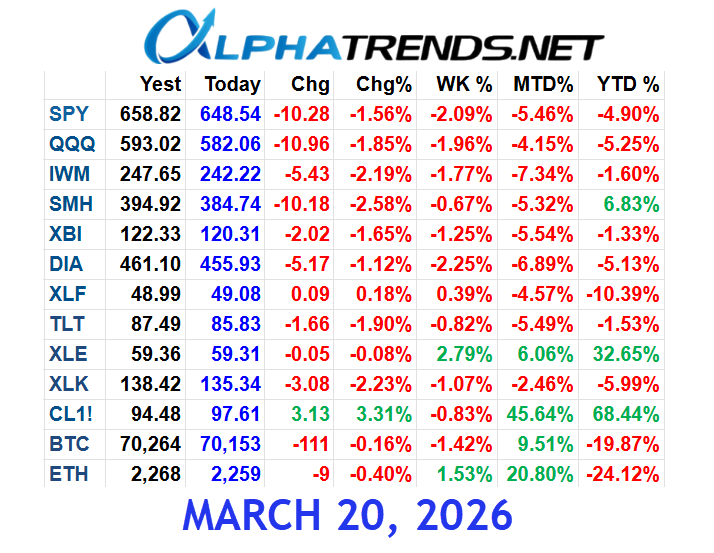
This week’s market analysis from Brian Shannon highlights a continued mixed-to-weak environment across major indexes, with relative strength in select areas like energy and semiconductors. While some short-term stabilization is occurring, the broader structure still requires caution, patience, and disciplined risk management. ⚓
Market Overview
The market remains in a choppy, corrective phase. Major indices are trading below key moving averages, with declining short-term trends still influencing price behavior. While there are attempts at stabilization, they have yet to develop into sustained upside momentum.
Technology and growth stocks continue to show mixed results, while energy-related sectors maintain relative strength. The broader takeaway is that this is still an environment where traders must stay selective and avoid forcing trades.
S&P 500 and Index Structure
The S&P 500 remains below key anchored VWAP levels and continues to struggle beneath declining moving averages. Short-term rallies have failed to produce meaningful follow-through, reinforcing the idea that sellers are still active on strength.
Attempts to reclaim higher levels have been met with resistance, and price continues to respect declining short-term averages. Until the index can reclaim and hold above these levels, the broader structure remains vulnerable.
Across major indices, including the NASDAQ and Russell 2000, the same pattern persists – price below declining 20-day and 50-day moving averages, combined with a lack of strong leadership.
Sector Rotation and Leadership
Semiconductors continue to show relative strength compared to the broader market. While not immune to volatility, this group has held up better than many others and remains an area to monitor for potential leadership if market conditions improve.
Energy remains a standout sector, supported by strong price action in oil. Trends continue to show higher highs and higher lows, reinforcing its position as one of the few areas with sustained momentum.
Financials remain weak and continue to underperform. Failed rallies and persistent selling pressure suggest caution when evaluating this group.
Metals and Commodities, including gold and silver, have shown mixed behavior. Weakness in gold following a break below key moving averages highlights the importance of monitoring short-term trend shifts even within longer-term structures.
Key Price Levels and Technical References
One of the most important aspects of this week’s analysis is the use of anchored VWAP and moving averages to define market context. Anchored VWAP from significant highs and lows continues to act as a key reference for support and resistance.
When price trades below these anchored levels, it signals that participants who entered at those points may be under pressure, often creating supply on rallies. Conversely, reclaiming these levels can indicate improving demand.
Short-term moving averages, particularly the 5-day, 20-day, and 50-day, remain critical for identifying trend direction. Declining averages continue to reinforce the current environment of lower highs and lower lows.
Trading Rules and Practical Tips
Brian emphasizes that market context should dictate strategy. In a market with declining moving averages and weak structure, traders should avoid aggressive dip-buying and instead focus on risk-defined setups.
When rallies occur below declining short-term moving averages, they should be viewed with skepticism. These moves often fail and can present opportunities for more cautious positioning rather than chasing strength.
Intraday tools such as VWAP can provide additional confirmation. When price loses VWAP after testing resistance, it often signals that sellers are regaining control for the session.
Traders should also pay close attention to the relationship between price and key moving averages. Stocks trading below declining 20-day and 50-day moving averages typically lack sustained upside momentum and carry higher risk.
Risk Management and Trade Execution
Risk management remains the most important component of trading in this environment. Traders should define risk before entering a position and avoid emotional decision-making driven by short-term price movements.
Using structured exit strategies, such as scaling out of positions as trends weaken or as key levels are broken, can help protect capital. Placing stops near logical support levels rather than arbitrary price points improves consistency and discipline.
Position sizing should remain conservative, especially when the broader market lacks clear direction. Preserving capital during uncertain conditions allows traders to take advantage of stronger opportunities when they emerge.
Key Takeaways for the Week Ahead
The market continues to show signs of a corrective phase rather than a strong trending environment. While certain sectors like energy and semiconductors offer relative strength, the broader market lacks the structure needed for aggressive long exposure.
The focus should remain on discipline, patience, and objective analysis. Traders who prioritize risk management and avoid forcing trades are better positioned to navigate this type of market.
As always, the goal is not to predict what the market will do next, but to respond to what price is actually doing. Anchored VWAP, moving averages, and price structure provide the framework for making those decisions.
If you want deeper insights into market structure, anchored VWAP strategies, and real-time analysis, explore more from Alphatrends below:
Follow Alphatrends on X for subscriber analysis
Learn more about Alphatrends Premium Membership