


End-of-Week Market Analysis – April 24, 2026
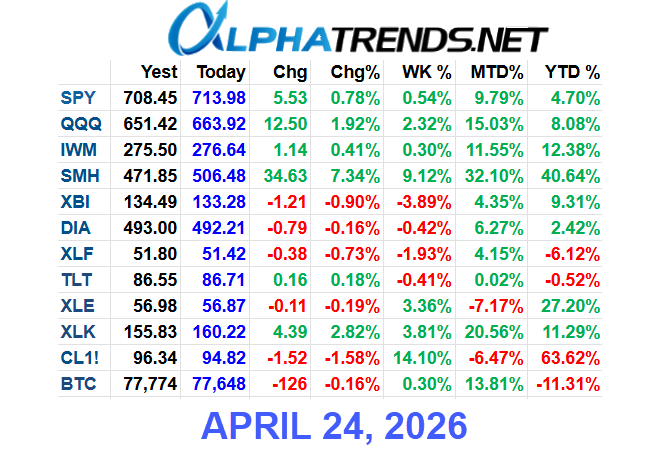
This week’s market analysis from Brian Shannon highlights a strong bullish environment despite conflicting macro signals. With semiconductors surging, oil rallying sharply, and major indices continuing higher, the key message is clear – trade the market in front of you, not what you think it “should” do. ⚓
Market Overview
It was a powerful week across equities. The S&P 500 and NASDAQ continued higher even as oil rallied significantly. Semiconductors led the charge with an impressive move, reinforcing their role as market leaders.
This type of price action is a reminder that markets do not always follow expected correlations. Oil strength is often seen as a headwind for equities, yet stocks continued higher. The takeaway is simple – price action matters more than assumptions.
Buyers remain firmly in control, supported by a pattern of higher highs and higher lows. The market continues to reward strength, particularly as earnings season begins to deliver generally positive reactions.
S&P 500 and Trend Structure
The S&P 500 spent much of the week consolidating after a strong prior move, then resumed its uptrend. This type of digestion is healthy in a bullish market and allows moving averages and support levels to catch up.
Short-term weakness, such as brief moves below the 5-day moving average, should not be interpreted as bearish signals in a strong uptrend. Instead, they serve as warnings to monitor risk and evaluate whether a deeper pullback may develop.
As long as the market continues to form higher lows and holds above key support levels, the trend remains intact. Buyers are in control until proven otherwise.
Risk Management in a Strong Market
Even in a bullish environment, risk management remains essential. Brian outlines a structured approach using multiple timeframes and moving averages to manage positions effectively.
Rather than exiting entirely on the first sign of weakness, traders can scale out of positions as price breaks below shorter-term moving averages. This allows participation in the trend while reducing exposure as conditions change.
Stops should be placed below relevant higher lows, not arbitrary levels. As the market moves higher and forms new higher lows, stops can be adjusted upward to protect gains and maintain discipline.
Semiconductors and Market Leadership
Semiconductors were the standout performers this week, delivering a strong rally and continuing their role as long-term leaders. The magnitude and speed of this move highlight the importance of participating in leading sectors rather than trying to fight the trend.
Stocks like NVIDIA, AMD, and Intel continue to provide opportunities for traders who focus on structure and timing. Even in extended conditions, shorter-term timeframes can offer low-risk entry points near VWAP or after pullbacks.
Trying to short strong leaders in a bullish market remains a high-risk strategy. Strength tends to persist longer than expected.
NASDAQ and Trade Opportunities
The NASDAQ continues to follow a clear pattern of higher highs and higher lows. This “innocent until proven guilty” structure defines a strong uptrend and provides a framework for trade planning.
For traders not currently positioned, the preferred strategy is to wait for a pullback that forms a higher low. Entries can then be taken with defined risk below that level.
Buying extended moves without a clear risk level exposes traders to larger drawdowns. Even in strong markets, disciplined entries remain critical.
Russell 2000 and Failed Moves
The Russell 2000 briefly broke below a prior low before quickly recovering. This type of failed move often leads to fast moves in the opposite direction, reinforcing the importance of monitoring structure rather than reacting emotionally to short-term price action.
Using staged exits and re-entry strategies allows traders to manage volatility while maintaining exposure to potential upside.
Biotech and Sector Rotation
Biotech pulled back after losing short-term support, moving toward key anchored levels and the 20-day moving average. Rather than buying the dip immediately, the preferred approach is to wait for stabilization and confirmation of renewed strength.
Brian outlines a scenario-based approach – allowing the sector to consolidate, form a higher low, and then participate with defined risk. This avoids catching falling prices and improves trade consistency.
Financials and Developing Structure
Financial stocks pulled back after an extended move higher and are now attempting to establish a higher low. This type of consolidation can set the stage for future upside if buyers regain control.
However, the key is patience. Traders should wait for evidence of strength before committing capital rather than attempting to predict the bottom.
Energy and Oil Dynamics
Oil rallied strongly during the week, but energy stocks showed mixed behavior as they encountered resistance near key anchored VWAP levels and moving averages.
This divergence highlights an important concept – related markets do not always move in sync. Each market should be evaluated independently based on its own structure and price action.
Anchored VWAP continues to serve as a critical tool for identifying areas of supply and demand. These levels are not automatic buy or sell signals but provide context for how price may behave.
Bitcoin and Crypto
Bitcoin continues to show a steady pattern of higher highs and higher lows, indicating improving structure. Despite this strength, the presence of a declining 200-day moving average suggests maintaining a measured approach rather than full exposure.
Scaling into positions and adding on pullbacks allows traders to participate while managing risk effectively.
Key Trading Takeaways
The dominant theme this week is to trust price over narrative. Markets can behave differently than expected, and relying on assumptions can lead to missed opportunities.
Strong trends should be respected, not fought. Buying strength with defined risk and avoiding emotional decisions improves long-term consistency.
At the same time, discipline remains critical. Even in a bullish market, managing position size, defining risk, and waiting for high-probability setups are essential for success.
If you want daily insights and real-time analysis using anchored VWAP, moving averages, and structured risk management, explore more from Alphatrends below.
Follow Alphatrends on X for subscriber analysis
Learn more about Alphatrends Premium Membership