



End-of-Week Market Analysis – March 27, 2026
This week’s market analysis from Brian Shannon reinforces a clear message that has been building for weeks – the market is in a bearish environment, and traders need to adjust accordingly. While there are occasional bounces and short-term opportunities, the dominant trend remains lower, with failed breakouts, weak structure, and continued selling pressure across most sectors. ⚓
Market Overview
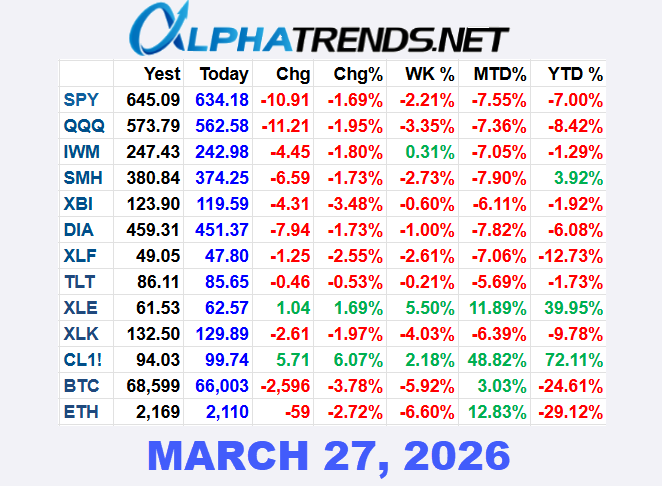
It was an overall weak week for equities, despite the Russell 2000 finishing slightly higher. That “relative strength” is misleading in this context, as the broader market continues to lose ground. The primary driver remains energy, with oil maintaining strength and contributing to pressure on equities.
The market continues to follow a familiar pattern – lower highs, lower lows, and price trading below declining moving averages. This is not a healthy environment for aggressive long exposure.
Oil, Bitcoin, and Macro Drivers
Oil remains a key influence. After briefly entering a “no man’s land” between anchored levels, it reclaimed strength and is now pushing back toward the upper end of its range. A continued move higher in oil is likely to remain bearish for equities.
Bitcoin continues to offer little edge. Price has repeatedly failed near the year-to-date anchored VWAP and is now back below key levels, with a likely move toward lower support zones. The structure remains range-bound and unreliable for sustained trends.
The broader takeaway is that macro pressures and leadership trends continue to favor caution in equities.
Market Structure and Trend Analysis
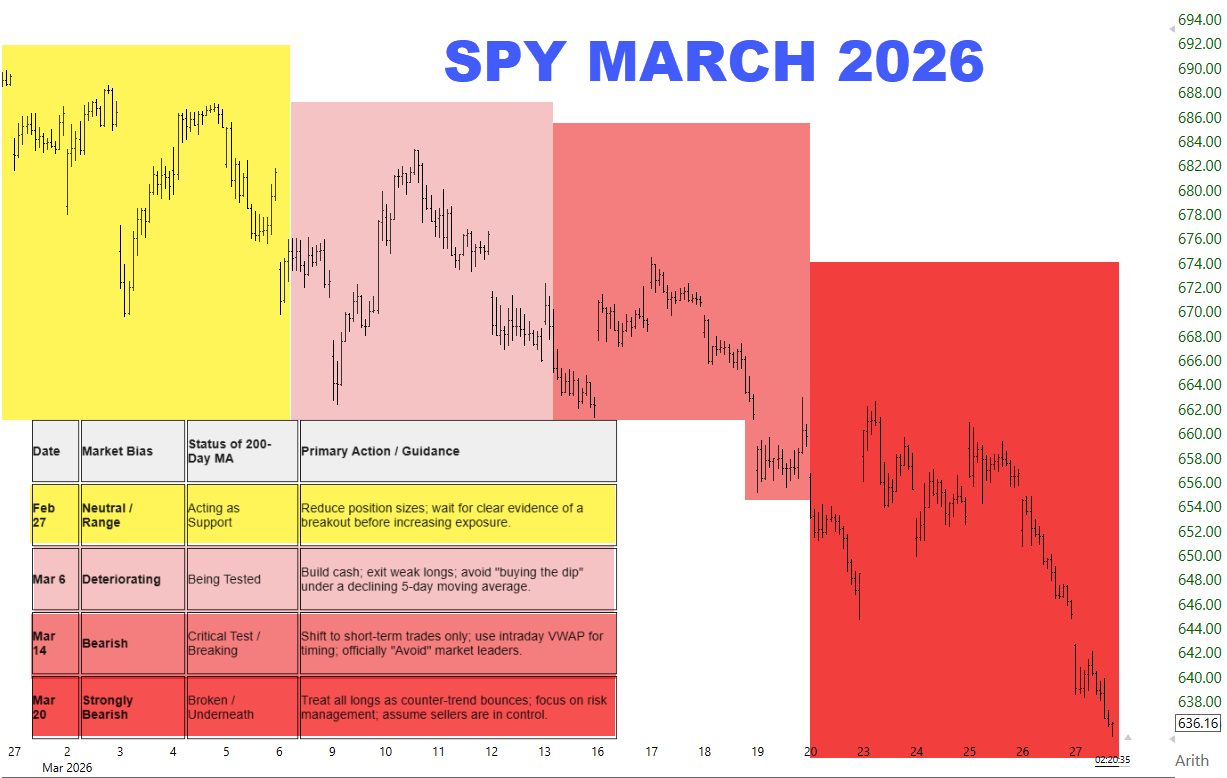
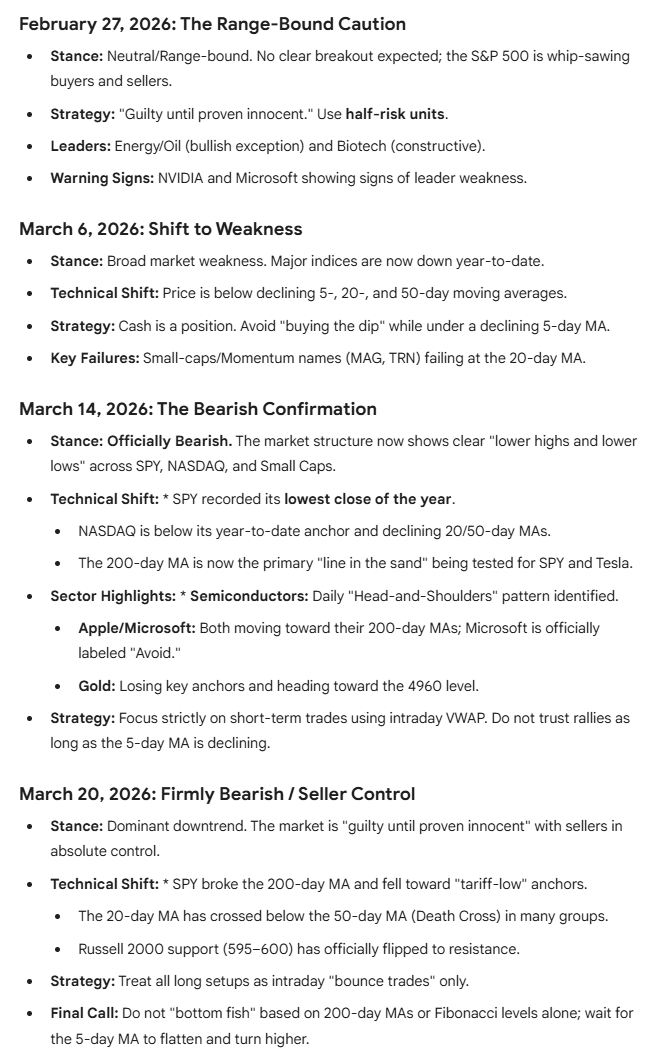
Across major indexes, the structure remains clearly bearish. Markets are trading below declining 5-day, 20-day, and 50-day moving averages, as well as key anchored VWAP levels from major highs and the start of the year.
Brian emphasizes a consistent principle: when moving averages are declining, the market is “guilty until proven innocent.” Rallies in this environment should not be trusted until there is clear evidence of buyers regaining control.
Recent price action shows repeated failures after short-term rallies. Markets briefly push higher into resistance zones, then quickly roll over as sellers step back in. This pattern continues to define the current environment.
Failed Breakouts and Trading Conditions
One of the most important characteristics of this market is the failure of breakouts. Stocks that appear to be breaking higher are quickly reversing and trapping traders who chase momentum.
This behavior highlights a key shift – strategies that worked in a bull market are no longer effective. Buying strength without confirmation or buying dips in weak stocks is consistently being punished.
Short selling is also challenging due to sharp counter-trend rallies driven by headlines. This creates a difficult environment on both sides of the market, reinforcing the need for smaller position sizes and tighter risk management.
NASDAQ, Russell 2000, and Broad Index Behavior
The NASDAQ has broken through major support levels and continues to show no evidence of sustained buying interest. Key levels such as the 200-day moving average and anchored VWAPs are acting as reference points, but not as guaranteed support.
Brian stresses that these levels are not signals to buy on their own. They are simply areas to observe price behavior. Without confirmation from buyers, they should not be treated as entry points.
The Russell 2000’s apparent strength is not a sign of leadership. In a market trading below declining moving averages, relative strength often reflects delayed selling rather than genuine demand.
Semiconductors and Trade Setups
Semiconductors have completed a head-and-shoulders pattern and experienced a sharp decline. While textbook price targets suggest further downside, Brian emphasizes that trading decisions should be based on probability, not theoretical targets.
After a sharp selloff, markets often become short-term oversold. This increases the likelihood of a bounce, but that bounce should be treated as an opportunity to evaluate potential failure rather than a reason to buy aggressively.
The preferred approach is to wait for a rally, identify a lower high, and then look for weakness to enter with defined risk. This provides a logical structure for both entry and stop placement.
Biotech, Financials, and Bonds
Biotech stocks are following the same pattern seen across the broader market – brief rallies followed by failure. These moves are consistent with a bearish environment where sellers remain in control.
Financials continue their downtrend with no signs of improvement. Lower highs and lower lows remain intact, and there is no reason to treat these moves as buying opportunities.
Bonds have declined significantly and are now at levels where a short-term bounce is possible. However, this does not represent a favorable long setup, and traders should avoid initiating new short positions after extended downside moves.
Leadership Stocks and Key Names
Many large-cap stocks continue to deteriorate. Microsoft remains below declining short-term moving averages, with no technical reason to be a buyer. Meta experienced sharp declines, reinforcing the idea that weakness tends to persist in a downtrend.
The broader lesson is that stocks below declining 5-day, 20-day, and 50-day moving averages are not candidates for long positions. News and unexpected moves tend to follow the direction of the prevailing trend.
Trading Strategy and Risk Management
This market requires a different mindset. Traders should reduce position size, remain flexible, and focus on shorter-term opportunities rather than expecting sustained trends.
When markets are extended to the downside, selling short at those levels carries risk. Instead, it is often more effective to wait for a bounce and evaluate whether that bounce fails.
Brian emphasizes trading based on probability rather than possibility. While many outcomes are possible, the goal is to identify the most likely scenarios based on market structure and manage risk accordingly.
Above all, discipline is critical. Fighting the trend in a bearish environment can lead to repeated losses, while aligning with market structure improves consistency.
Key Takeaways
The market remains in a clear downtrend. Rallies are failing, breakouts are unreliable, and most sectors continue to weaken. While short-term bounces are likely, they should be viewed within the context of a broader bearish structure.
Traders who adapt to this environment by managing risk, avoiding emotional decisions, and respecting market structure will be better positioned to navigate the volatility.
If you want daily insights and real-time analysis based on anchored VWAP, moving averages, and price structure, explore more from Alphatrends below.
Follow Alphatrends on X for subscriber analysis
Learn more about Alphatrends Premium Membership